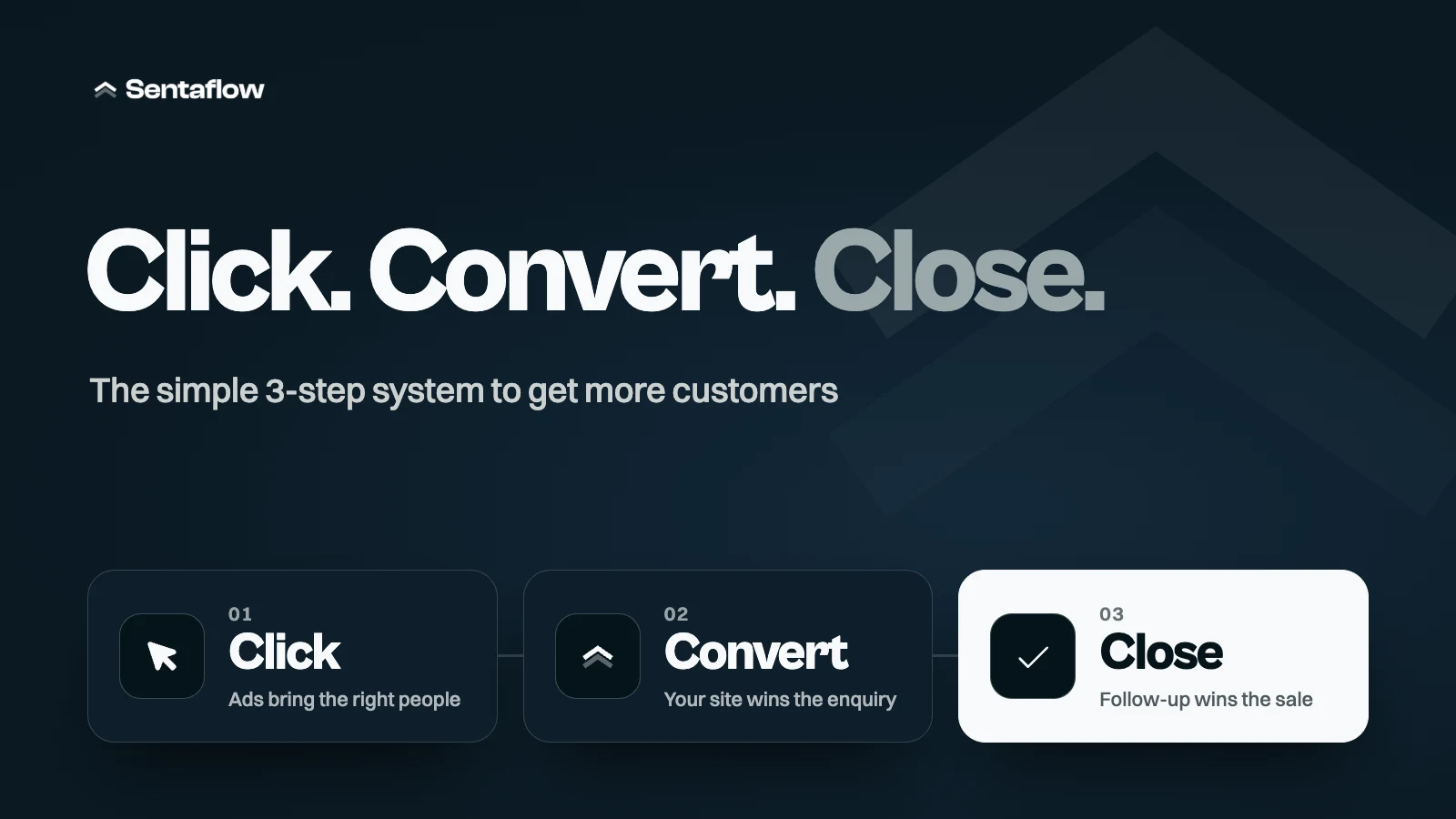
To get more customers, work on three steps in order. Click: get in front of people who are already looking for what you sell, mainly through Google Search, your Google Business Profile and targeted social ads. Convert: send them to a fast, mobile-friendly page with one clear next step. Close: reply to every enquiry within minutes and follow up until you get an answer. Speed matters most: calling a new lead within one minute lifted conversions by 391% in a study of 3.5 million leads.
Why most businesses struggle to get customers
When enquiries dry up, the usual response is to do more marketing: boost a post, try a new ad, redesign the logo. Sometimes it helps for a week. Usually it doesn't, because the problem was never a lack of attention. It was a leak further down.
Every new customer, whether they find a plumber, an accountant or an online store, goes through the same three steps:
They find you and click through.
Your page turns the visit into an enquiry.
Your follow-up turns the enquiry into a sale.
The steps multiply, so the weakest one sets your ceiling. A business with great ads, an average website and slow replies gets average results, no matter how much it spends on ads. The good news is that the fixes are mostly practical, cheap and within your control. Here's how to work through each step.
Step 1: get in front of the right people
The goal of this step isn't the most traffic. It's the right traffic: people who need what you sell, in the area you serve, at the moment they're ready to act. Start with the channels where that intent already exists.
Start where people are already searching
When someone types "electrician Centurion" or "accountant for small business" into Google, they've already decided to buy. They're choosing who from. That's why Google Search is usually the best first channel for a service business: you're not creating demand, you're catching it.
- Google Business Profile (free). This is what shows in Google Maps and the local results. Complete every field, choose the right categories, add real photos and ask happy customers for reviews. For many local businesses it brings more calls than the website.
- Google Search ads. Bid on the searches that show buying intent ("plumber near me", "emergency plumber Pretoria"), not vague ones ("how to fix a tap"). Start with a small, tight list of keywords and add more once you see which ones bring enquiries.
- Facebook and Instagram ads. These reach people who aren't searching yet. They work well for things people buy on impulse or from inspiration (online stores, events, home improvements), and for staying in front of people who visited your site but didn't enquire.
Send each ad to the right page
An ad for "emergency plumbing" should land on a page about emergency plumbing, with the phone number at the top. Not on your homepage, where the visitor has to hunt for it. Matching the page to the ad is one of the cheapest improvements you can make.
Mistakes that waste your budget
- Targeting the whole country when you only serve one city.
- Bidding on broad keywords that attract job seekers and DIY researchers.
- Sending every ad to the homepage.
- Running ads without conversion tracking, so you never know which ad brought which enquiry.
- Judging ads by clicks or likes instead of enquiries.
R5,000 ÷ 20 enquiries = R250 per enquiry. Compare it to what a customer is worth to you, not to what other businesses pay.Step 2: turn visitors into enquiries
This is where most of the money leaks out. You've paid for the click, and now the page has a few seconds to convince a stranger that you can help. Most visitors are on a phone, often on mobile data, and they'll leave at the first sign of friction.
Every second of loading costs you visitors
If the page isn't ready in three seconds, more than half of mobile visitors are gone before they read a word.
What a page that converts looks like
You don't need a big website to get enquiries. You need one page that does its job. Whether it's your homepage, a service page or a landing page for an ad, it should have these six things:
Anatomy of a page that converts
Top to bottom, on a phone screen.
- A headline about their outcome. "Burst geyser fixed today, anywhere in Pretoria East", not "Welcome to ABC Plumbing".
- One clear action, near the top. A call or WhatsApp button that's easy to tap with a thumb.
- Proof straight away. Google reviews, a star rating, recognisable clients or before-and-after photos.
- What they get and what happens next. Short and specific: "We call you back within 15 minutes."
- A short form. Name, number and one question. Every extra field loses people.
- Answers to the doubts that stop them. Price ranges, areas served, guarantees, how long it takes.
Test it yourself in two minutes
Click your own ad, or search for your business, on your phone and over mobile data. Can you tell within five seconds what you offer and where? Can you call or message with one tap? Can you fill in the form with your thumb? If anything is annoying for you, it's worse for a stranger who doesn't know you yet.
20 enquiries ÷ 600 visitors = 3.3%. If it's low, fix the page before you add more traffic.Step 3: turn enquiries into customers
An enquiry is not a customer yet. It's a person who has probably contacted two or three businesses at once, and they'll usually go with the first one that gets back to them properly. Most businesses are far slower than they think. When Harvard Business Review audited 2,241 companies by sending them web enquiries, the average reply took 42 hours, and almost a quarter never replied at all.[2]
How fast do businesses actually reply?
2,241 companies were sent a web enquiry. Here's when they answered.
That's good news for you. If most of your competitors reply slowly, simply replying fast puts you ahead before you've said a word about price or quality.
Reply where your customers already are
In South Africa that usually means WhatsApp. Many people would rather send a message than make a call, and they check WhatsApp far more often than email. Make it easy to reach you there, and reply there too.
A simple follow-up sequence that works
Most enquiries that turn into sales don't answer the first call. Velocify found that 93% of the leads that converted were reached by the sixth call attempt.[1] You don't need to be pushy. You need a plan, so nobody falls through the cracks:
The follow-up sequence
From the moment an enquiry arrives.
- Instant replyAn automatic SMS, WhatsApp or email: "Thanks, we'll call you in the next few minutes", with a link to book a time.
- Call themWhile they're still thinking about the problem. If there's no answer, leave a short voicemail.
- WhatsApp messageShort and helpful: answer their question or suggest two times to talk.
- Second callTry a different time of day.
- Value follow-upSend something useful: a price guide, a photo of similar work, a review from a similar customer.
- Last check-in"Should I close your enquiry, or is it still something you need?" This often gets a reply.
For online stores, the same idea applies to abandoned checkouts: a reminder within an hour, another the next day, and sometimes a small reason to finish the order.
customers ÷ enquiries. Example: 6 customers ÷ 20 enquiries = 30%.What happens when you reply in 60 seconds
The first minute is worth more than any other. Velocify looked at about 3.5 million leads and found that calling a new lead within one minute increased conversions by 391%. Wait two minutes and the lift drops to 160%. Wait an hour and it's down to 36%.[1]
The value of a lead drops by the minute
Increase in conversions, depending on how quickly a new lead is called.
Other research says the same thing. Responding within five minutes instead of thirty makes you 100 times more likely to reach the person and 21 times more likely to qualify them.[3] In the HBR study, businesses that replied within an hour were about seven times more likely to qualify the lead than those who waited just one hour longer.[2]
The lead clock
How much more likely you are to qualify a lead when you reply first.
If you can't answer every call yourself, don't let that stop you. An automatic reply in the first minute, followed by a call as soon as you're free, already beats most of your competitors.
How the three steps multiply
Because each step feeds the next, small improvements compound. Here's a simple example with round numbers.
Same ad budget, two outcomes
1,000 clicks from the same ads. Only the website and follow-up change.
The ads didn't change at all. The business tripled its customers by fixing the two steps after the click. Spending more on ads first would have bought more clicks for the same leaky process, and pushed the cost of each customer up.
Fix the weakest step first. It almost always does more than spending more on the strongest one.
Want a second pair of eyes on your three steps?
On a free 30-minute strategy call we'll look at your ads, your website and your follow-up, and tell you honestly which step to fix first.
Book a strategy callA 30-day plan to get started
You don't need to fix everything at once. Work through one week at a time and you'll have the basics of a working system in a month.
Your first 30 days
Small, practical steps, in the order that pays off fastest.
- Set up an instant auto-reply
- Decide who calls new enquiries, and how fast
- Start a simple lead list or CRM
- Test your site on your phone
- Rewrite the headline around the outcome
- Add a WhatsApp button and reviews
- Complete your Google Business Profile
- Ask five happy customers for reviews
- Set up conversion tracking
- Start a small, tightly targeted ad test
- Track cost per enquiry and reply time
- Fix the weakest number first
Score your business
Answer honestly. The first row where you can't say yes is the step to work on next.
| Step | Ask yourself | Good sign |
|---|---|---|
| Click | Do I know what each new enquiry costs me, and which channel it came from? | You can name your cost per enquiry for last month. |
| Convert | If I clicked my own ad on my phone, would I enquire? | Page loads fast, one clear action, reviews visible. |
| Close | How long does a new enquiry wait for a real reply? | Minutes, not hours, including after-hours enquiries. |
| All three | Do I see these numbers every week? | One simple weekly report: enquiries, customers, cost per customer. |
- Every customer takes three steps: click, convert, close. The weakest step limits your results.
- Start with channels where people already search: your Google Business Profile and Google Search ads.
- Send each ad to a matching, fast, mobile-friendly page with one clear action.
- Reply within minutes. Calling within one minute lifted conversions by 391% in one study; the average business takes 42 hours.
- Follow up several times. Most leads that buy don't answer the first call.
- Track three numbers every week: cost per enquiry, conversion rate and reply time.
Frequently asked questions
What is the fastest way to get more customers?
Improve your follow-up. It costs nothing and it improves every enquiry you already get. Reply to new enquiries within minutes and follow up several times before giving up.
How do I get customers online for free?
Complete your Google Business Profile, collect reviews from happy customers, and make sure your website loads fast and makes it easy to call or WhatsApp you. Paid ads speed things up, but these free basics make every rand you spend work harder.
Should I use Google Ads or Facebook Ads?
For most service businesses, start with Google Search, because people are already looking for what you sell. Facebook and Instagram work well for online stores, impulse purchases and reminding people who visited but didn't enquire.
How much should I spend on ads?
Start with a test budget you're comfortable with, track the cost per enquiry, and compare it to what a new customer is worth to you. Increase spend only once the website converts and the follow-up is fast.
Do I need a new website to get more customers?
Not always. Often fixing the headline, the call to action, the speed on mobile and the proof on your existing page is enough. If the site is slow or hard to change, a dedicated landing page for your ads is a quick win.
Sources
- Velocify (Leads360), lead response research across roughly 3.5 million leads, reported via PR Newswire
- Oldroyd, McElheran and Elkington, "The Short Life of Online Sales Leads", Harvard Business Review, March 2011
- Lead Response Management Study, Dr James Oldroyd with InsideSales.com, 2007, as summarised by Booked in Blue
- Google / SOASTA, "The Need for Mobile Speed", 2016, reported by Marketing Dive
Rather have this done for you?
Sentaflow runs all three steps for South African businesses: the ads, the website and the follow-up, with one weekly report on what each new customer cost. Start with a free 30-minute strategy call.
Book a strategy call
Founder of Sentaflow. We run customer acquisition for South African businesses, from the ads to the website to the follow-up.